
Solar loans transform the upfront cost of going solar into manageable monthly payments, letting homeowners finance a solar panel system for anywhere from five to 25 years with interest rates typically ranging between 3% and 10%. These specialized financing products work much like auto loans or mortgages, allowing you to own your system outright while paying over time, but they come with unique charges and fee structures that can significantly impact your total cost. Understanding dealer fees, loan origination costs, and buydown charges is essential before signing any agreement, as these can add thousands to your final price tag.
The appeal is straightforward: own your solar system without the $15,000 to $40,000 upfront investment that full cash purchases demand. You’ll qualify for federal tax credits and local incentives, build home equity, and start cutting electricity bills immediately. However, the solar sales process can obscure the true cost of financing. Some installers roll dealer fees into the loan principal, others inflate system prices to cover lender buydowns, and a few bury prepayment penalties in fine print.
As renewable energy trends continue driving residential adoption in 2026, solar loans have become the most popular financing method, accounting for nearly half of all new installations. This guide breaks down exactly how solar loans work, what charges you’ll encounter at every stage, who qualifies for the best rates, and where to find transparent lenders. You’ll learn to compare the total cost of ownership across loan terms, spot hidden fees that inflate your payments, and understand your rights as a borrower in a market that still lacks full regulatory standardization.
What Solar Loans Are and How They Work
Secured vs. Unsecured Solar Loans
Secured solar loans use your home as collateral, typically through home equity lines of credit (HELOCs) or home equity loans. Because the lender can claim your property if you default, these products carry lower interest rates, often 4% to 8% in 2026, and may qualify you for tax-deductible interest payments. Approval hinges on existing home equity and a solid credit profile, making them harder to obtain for recent homeowners or those with limited equity built up. The trade-off for lower rates is real risk: if you fall behind on payments, you could lose your home.
Unsecured solar loans don’t require collateral, so approval focuses on creditworthiness rather than property value. Interest rates run higher, typically 6% to 12%, reflecting the lender’s increased risk, but you avoid putting your home on the line. Many solar installers partner with specialty lenders offering unsecured products designed specifically for solar projects, with streamlined approvals and terms aligned to solar savings timelines. These loans often allow paydown using the Residential clean energy credit within 18 months to reduce effective interest costs.
| Loan Type | Collateral | Typical Rate | Approval Difficulty | Best For |
|---|---|---|---|---|
| Secured (HELOC/Home Equity) | Home equity required | 4-8% | Moderate to high | Homeowners with substantial equity seeking lowest rates |
| Unsecured Solar Loan | None | 6-12% | Low to moderate | Buyers wanting quick approval without risking home |
Your choice depends on how much equity you hold, your tolerance for risk, and whether you prioritize the lowest possible rate or faster, simpler approval. Homeowners with strong equity positions often favor secured loans for their cost savings over 20-year terms, while those newer to homeownership or unwilling to leverage their property lean toward unsecured options despite higher monthly payments.
Common Loan Terms and Structures
Solar loans typically come in four standard repayment periods: 10, 15, 20, or 25 years. The shorter the term, the higher your monthly payment, but you’ll pay significantly less interest over the life of the loan. A 10-year loan might carry a monthly payment of $150-200 per thousand dollars borrowed, while a 25-year term could drop that to $60-80, making the latter more manageable month-to-month but costlier overall.
Solar loan terms range from around 3% to 9% APR in 2026, depending on your credit profile and whether the loan is secured. Most solar loans use fixed interest rates, which lock in your rate for the entire term and make budgeting predictable. Variable-rate solar loans exist but are less common, tying your interest to market indexes and introducing uncertainty as rates fluctuate.
The real cost difference becomes stark when you run the numbers. On a $20,000 solar loan at 5% interest, a 10-year term costs roughly $5,300 in total interest, while a 25-year term racks up about $14,000, nearly triple the interest for the same principal. That’s the trade-off: lower monthly obligations now versus substantially more paid over time.
Watch for dealer fees embedded in many solar loan products. Lenders often pay installers a commission of 10-30% of the loan amount, which may be rolled into your quoted system price or loan balance. Some lenders offer 18-month same-as-cash promotions that waive interest if you make a substantial principal payment early, typically using your federal tax credit. These structures can work in your favour, but only if you understand the terms upfront and plan accordingly.
Eligibility Requirements for Solar Loans
Credit Score and Financial Health
Your credit score is the single most important factor lenders examine when deciding whether to approve your solar loan application and what interest rate to offer. Most solar lenders use FICO scores, with the majority requiring a minimum score of 650 to qualify, though some programs accept scores as low as 600.
Lenders typically categorize applicants into tiers that directly impact your financing terms. Borrowers with excellent credit (740 and above) qualify for the lowest interest rates, often between 4.99% and 7.99% in 2026, which translates to significantly lower total interest paid over the loan term. Good credit scores (670-739) receive mid-tier rates, typically 8% to 11%, while fair credit (620-669) faces higher rates ranging from 11% to 15% or more. The difference is substantial: on a $25,000 loan over 20 years, a 6% rate costs roughly $11,000 in interest, whereas a 12% rate costs approximately $27,000.
Beyond your score, lenders assess your debt-to-income ratio, payment history, and credit utilization. They want to see that solar loan payments will not exceed 43% of your gross monthly income when combined with existing debts.
If your credit needs improvement, consider options like co-signing with someone who has stronger credit, applying for a secured loan using home equity (which may offer better terms despite lower scores), or working with specialized lenders that focus on near-prime borrowers. Some solar installers partner with multiple lenders across different credit tiers, giving you comparison options even with challenged credit.
Property and System Requirements
Most lenders evaluate your property alongside your finances before approving a solar loan. You’ll typically need to own your home outright or have a mortgage with sufficient equity, renters and some condominium owners face restrictions, though some lenders work with HOA-approved installations.
Roof condition matters significantly. Lenders and installers want roofs with at least 10-15 years of remaining life, since removing and reinstalling panels for roof replacement is expensive. Asphalt shingle, metal, and tile roofs generally qualify, while wood shake or slate may require specialized mounting or disqualify the property entirely. Excessive shading from trees or neighboring structures can render your roof unsuitable, as systems need adequate sun exposure to generate the energy projections that justify the loan amount.
Some lenders set minimum system size requirements, often 3-5 kilowatts, to ensure the installation value supports the loan. For secured loans using home equity, expect a property appraisal to verify your home’s value exceeds the combined mortgage and solar loan balance. The appraisal cost, typically $300-600, may be your responsibility or rolled into closing costs.
Structural concerns like foundation issues or code violations can delay or derail approval until resolved.
How to Apply for a Solar Loan
Documentation You’ll Need
Gathering the right paperwork before you start your solar loan application speeds up the process and reduces back-and-forth with lenders. Most solar financing companies require similar documentation to verify your identity, income, creditworthiness, and property ownership. Having these items ready in digital format makes the application smoother, especially since many lenders now process applications entirely online.
- Government-issued photo ID (driver’s license or passport)
- Recent pay stubs (typically last 2-3 months) or proof of income for self-employed applicants
- Last two years of tax returns with all schedules
- Proof of homeownership (property deed, mortgage statement, or title insurance)
- Credit authorization form (signed consent for the lender to pull your credit report)
- Recent utility bills (last 3-6 months showing current electricity usage and costs)
- Homeowners insurance policy documents
- Photo or documentation of existing roof condition (sometimes requested upfront)
Self-employed borrowers or those with non-traditional income streams should expect additional scrutiny. Lenders may request profit and loss statements, bank statements covering several months, or 1099 forms to verify consistent income. If you’re applying for a secured loan using home equity, the lender will likely require a recent property appraisal or authorize one as part of the approval process, adding both time and potential cost to the application.
Timeline from Application to Installation
Understanding the timeline for your solar loan and installation helps you plan appropriately and avoid surprises. The entire process typically spans two to three months from initial application to a fully operational system, though this varies based on your location, lender, and local permitting requirements.
Pre-qualification happens fastest, often within minutes if you apply online or a few days if working through your installer. Lenders conduct a soft credit check and review basic financial information to provide an initial rate estimate without impacting your credit score. This gives you a starting point for budgeting and comparing offers.
Full loan approval takes one to two weeks once you submit complete documentation. The lender performs a hard credit inquiry, verifies your income and employment, confirms property ownership, and finalizes your interest rate and loan terms. You’ll receive a formal loan commitment outlining all terms, fees, and your monthly payment amount.
Installation scheduling represents the longest phase, typically two to eight weeks. Your installer must obtain permits from your local building department, secure utility company approval for grid connection, and schedule the actual installation crew. Urban areas with streamlined permitting may move faster, while rural jurisdictions or regions with complex approval processes can push toward the longer end of this range.
Final loan funding occurs either upon installation completion or through milestone payments. Many lenders release funds directly to the installer once your system passes final inspection and connects to the grid, closing the financial loop on your solar investment.
Understanding Solar Loan Charges and Fees

Interest Rates and APR
Interest rates on solar loans typically range from 3% to 10% in 2026, depending on your creditworthiness and the lender. However, the advertised interest rate tells only part of the story. What you really need to examine is the Annual Percentage Rate (APR), which captures the true cost of borrowing by including both the interest rate and most fees rolled into the loan.
Here’s the critical distinction: a loan advertising a 5.99% interest rate might carry a 7.2% APR once you factor in origination fees and other charges built into the financing. This difference can add thousands to your total repayment over a 20-year term. Always compare APRs between lenders, not just interest rates.
Several factors determine the rate you’ll receive. Credit scores above 740 typically qualify for the lowest rates, while scores between 640-740 face moderate increases. Your debt-to-income ratio matters too, lenders prefer ratios below 43%. The loan type also plays a role: secured loans backed by home equity generally offer lower rates than unsecured options because they carry less risk for lenders.
Loan term length affects rates as well. Shorter 10-year loans often come with lower rates than 25-year terms, though monthly payments run higher. Some lenders also adjust rates based on whether you choose automatic payments or agree to an 18-month principal reduction using your federal tax credit.
Origination and Closing Costs
When you take out a solar loan, lenders typically charge origination fees to cover the administrative cost of processing your application, verifying your credit, and establishing the loan account. These fees generally range from 0% to 5% of the total loan amount, though the exact percentage varies by lender and your creditworthiness.
On a $25,000 solar loan with a 2% origination fee, you’d pay $500 upfront, or more commonly, the lender rolls that fee into your total loan balance, meaning you’d actually borrow $25,500. Rolling fees into the loan reduces your immediate out-of-pocket expense but increases the total interest you’ll pay over the loan’s lifetime, since you’re borrowing against the fee itself.
Some lenders advertise “no origination fee” loans but compensate by offering slightly higher interest rates instead. Compare the annual percentage rate across offers rather than focusing solely on whether a fee exists, as APR reflects the true cost including all fees. Closing costs for secured solar loans (those using your home as collateral) may also include appraisal fees, title search fees, or recording fees, similar to mortgage closing costs. Unsecured solar loans rarely involve these additional charges but may have higher origination fees to offset the lender’s increased risk.
Dealer Fees and Hidden Costs
Many solar installers partner with financing companies that pay them a commission, known as a dealer fee, for each loan originated. This fee typically ranges from 10% to 30% of the system price, and it’s almost always passed on to you, the borrower. The installer doesn’t absorb this cost, instead, it gets baked into either a higher quoted system price or a larger loan amount. You might never see it itemized on your contract, which is precisely why it’s considered a hidden cost.
Here’s how it works: an installer might quote you $25,000 for a system if you finance through their preferred lender, but only $20,000 if you pay cash. That $5,000 difference is essentially covering the dealer fee the lender pays the installer. You end up financing not just the solar panel cost but also the commission the installer receives for steering you toward that particular loan product.
To identify these fees, always request two quotes from every installer: one for cash payment and one for financing. The gap between these numbers reveals the true dealer fee being charged. Many homeowners find the cash price is 15-25% lower. You can then negotiate, ask the installer to reduce the financed price or offer to finance through your own credit union or bank, which typically doesn’t charge dealer fees.
Some lenders advertise “zero dealer fee” loans with slightly higher interest rates instead, which can be more transparent. Compare the total cost over the loan term, not just the monthly payment, to determine which option actually saves you money.
Prepayment Penalties and Early Payoff
Most solar loans marketed as “no prepayment penalty” products allow borrowers to pay down or eliminate their loan balance early without triggering additional fees. This flexibility matters because many homeowners plan to use their federal Investment Tax Credit refund, typically 30% of the system cost, to reduce the principal within the first 18 months of installation. Making this early payment can significantly lower the loan’s effective interest rate and reduce total interest paid over the life of the loan.
However, some solar financing products use a “re-amortization” structure where failing to make the expected 18-month paydown doesn’t incur a penalty per se, but results in higher monthly savings being offset by increased monthly payments. The loan recalculates at month 18 assuming you’ve paid down a specific amount (usually matching the tax credit value). If you haven’t, your monthly payment jumps to cover the unpaid balance over the remaining term.
Always verify your loan’s early payment terms in writing. Ask whether payments above the minimum go directly to principal reduction and whether there’s any period during which prepayment affects your rate or payment structure.
Your Rights and Obligations as a Solar Loan Borrower
Federal Tax Credits and Loan Obligations
When you finance a solar installation with a loan, you own the system outright, which means you’re eligible for the federal Investment Tax Credit (ITC), currently worth 30% of your total system cost through 2032. This is a crucial advantage over leases or power purchase agreements, where the third-party owner claims the credit, not you.
Here’s the practical reality: most solar loans are structured to work in tandem with the ITC. Many lenders build in an 18-month window during which you can make a substantial principal payment, ideally using your tax credit refund, without penalty. If you take advantage of this, you reduce your loan balance significantly, which lowers your total interest paid over the life of the loan. For example, on a $25,000 system, the ITC gives you $7,500 back at tax time. Applying that to your loan principal in month 18 can save thousands in interest charges.
If you don’t make that payment, your monthly installments typically increase to cover the interest that would have been avoided. Some lenders automatically adjust your payment schedule upward after 18 months; others maintain the same payment but extend the term. Understanding the cash price vs financed total cost helps you evaluate whether using the credit for paydown makes sense for your situation, or whether you’d rather use those funds elsewhere and accept the higher financing cost.
What Happens If You Sell Your Home
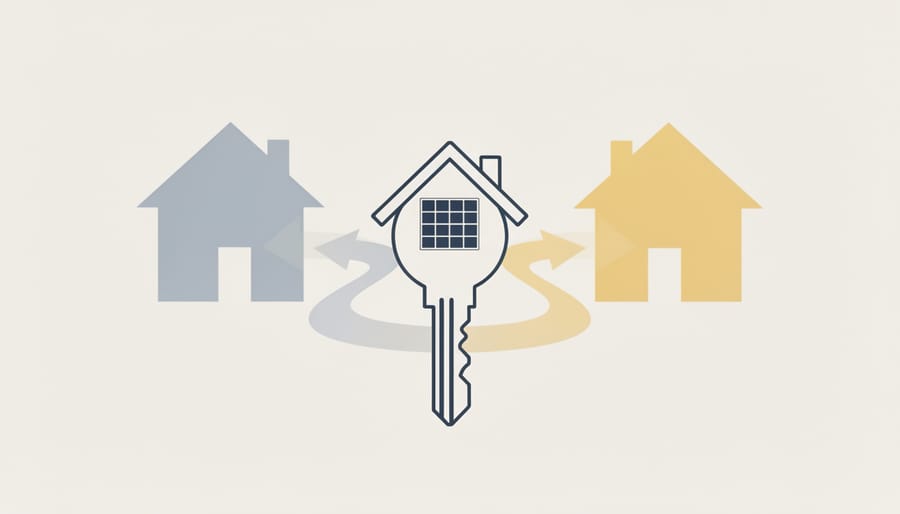
When you sell a home with an active solar loan, you have three primary options to handle the remaining debt. The most straightforward approach is paying off the loan balance at closing using proceeds from the sale. This clears the lien and transfers full system ownership to the buyer, which often makes the home more attractive since buyers receive a paid-off solar system that immediately reduces their energy costs.
Some lenders permit loan assumption, allowing the buyer to take over your remaining payments. This option requires the buyer to meet the lender’s credit and income qualifications, and not all solar loan products allow transfers. You’ll need to check your loan agreement and contact your lender well before listing to understand if this option exists and what documentation the buyer would need.
The third approach involves factoring the solar system’s value into your asking price while leaving the loan in place through closing, then paying it off with sale proceeds. Homes with solar panels typically sell faster and command premium prices, particularly in markets where energy costs are high. Real estate agents familiar with solar properties can help position the system as a value-add rather than a complication during negotiations.
Where to Get Help and Find Reputable Solar Lenders
Questions to Ask Your Lender and Installer
Before signing a solar loan agreement, arm yourself with specific questions that reveal the full financial picture. The answers you receive will help you compare offers accurately and avoid unpleasant surprises after installation.
Start by asking your installer for the cash price of the system versus the financed price. This comparison exposes any dealer fees or financing premiums built into the loan amount. Request a detailed breakdown of all costs: equipment, labor, permits, and any financing charges. If the financed price exceeds the cash price by more than a few hundred dollars, you’re likely covering lender dealer fees that could add thousands to your total cost.
Inquire about loan transfer policies before you commit. Ask whether the loan can be transferred to a new homeowner if you sell, what fees apply for transfer, and whether the lender has ever denied a transfer request. Some lenders make transfers difficult, forcing you to pay off the entire balance at closing.
Clarify all warranty terms and their relationship to loan performance. Ask whether equipment warranties remain valid if you refinance or pay off the loan early, and whether production guarantees are contingent on maintaining the loan. Some agreements tie warranty service to ongoing loan payments, creating potential conflicts.
What’s the difference between the financed price and cash price?
The financed price typically includes dealer fees, commissions the installer receives from the lender, which can add 15-30% to the system cost. Always request both prices to see the true financing premium.
Can I pay off my solar loan early without penalty?
Most solar loans allow early payoff without penalty, and many are structured to encourage an 18-month principal reduction using your federal tax credit. Confirm this in writing before signing.
What happens if the system underperforms or breaks down?
Your loan obligation continues regardless of system performance. Verify that performance guarantees and equipment warranties are independent of loan status and cover repair costs without affecting your payment schedule.
Are there any fees not disclosed in the initial quote?
Ask specifically about origination fees, documentation fees, late payment charges, loan transfer fees, and any ongoing account maintenance costs. Request all fees in writing as part of your loan estimate.
Don’t hesitate to ask your lender about prepayment strategies. Find out if making an early principal payment reduces your interest rate, how to apply your tax credit to the loan balance, and whether partial prepayments lower your monthly obligation or shorten the loan term. Understanding these mechanics helps you minimize total interest costs and gives you flexibility as your financial situation evolves.
Government Resources and Consumer Protection
When navigating solar financing, several trusted government and nonprofit organizations offer free guidance to protect your interests and clarify your options.
The Federal Trade Commission (FTC) maintains comprehensive consumer alerts about solar marketing practices and financing pitfalls. Their website explains common sales tactics, red flags to watch for, and your legal rights when dealing with solar companies. The FTC’s “Going Solar” resource page breaks down different financing models and warns against high-pressure sales techniques.
The Consumer Financial Protection Bureau (CFPB) provides detailed information about solar loans as consumer credit products. Their resources explain how Truth in Lending Act protections apply to solar financing, what disclosures lenders must provide, and where to file complaints if a lender violates federal lending laws. The CFPB also offers guidance on understanding loan terms and comparing offers.
Most states operate energy offices or clean energy programs that list approved solar incentives, vetted installers, and sometimes preferred financing partners. These state agencies typically maintain current information about local tax credits, rebates, and Property Assessed Clean Energy (PACE) programs where available. California’s Self-Generation Incentive Program, New York’s NYSERDA, and similar state offices provide region-specific financing guidance.
Nonprofit organizations like the Solar Energy Industries Association (SEIA) and EnergySage offer educational resources, installer directories, and comparison tools. These platforms don’t charge consumers and provide unbiased information to help you evaluate competing solar loan offers before signing.
Solar loans have democratized access to clean energy, allowing homeowners and businesses to install systems without shouldering the entire cost upfront. However, the path to ownership requires careful navigation of interest rates, origination fees, dealer commissions, and prepayment terms that can significantly impact your total investment. A loan advertised at one rate might carry hidden dealer fees that inflate the system price by thousands of dollars compared to cash pricing.
Before signing any agreement, request detailed breakdowns of all charges, compare at least three financing offers, and ask your installer for their cash price alongside loan options. Understand how the federal tax credit fits into your repayment strategy and whether your loan allows penalty-free early payoff. Consider not just what you’ll pay monthly, but what the system will actually cost over the loan’s full term.
Despite these complexities, solar loans remain the most practical route to ownership for most buyers in 2026. They preserve your ability to claim tax incentives, increase your property value, and eliminate utility bills, all while contributing to a cleaner energy future. Informed borrowers who scrutinize the fine print consistently find financing structures that align with both their budgets and their environmental goals.